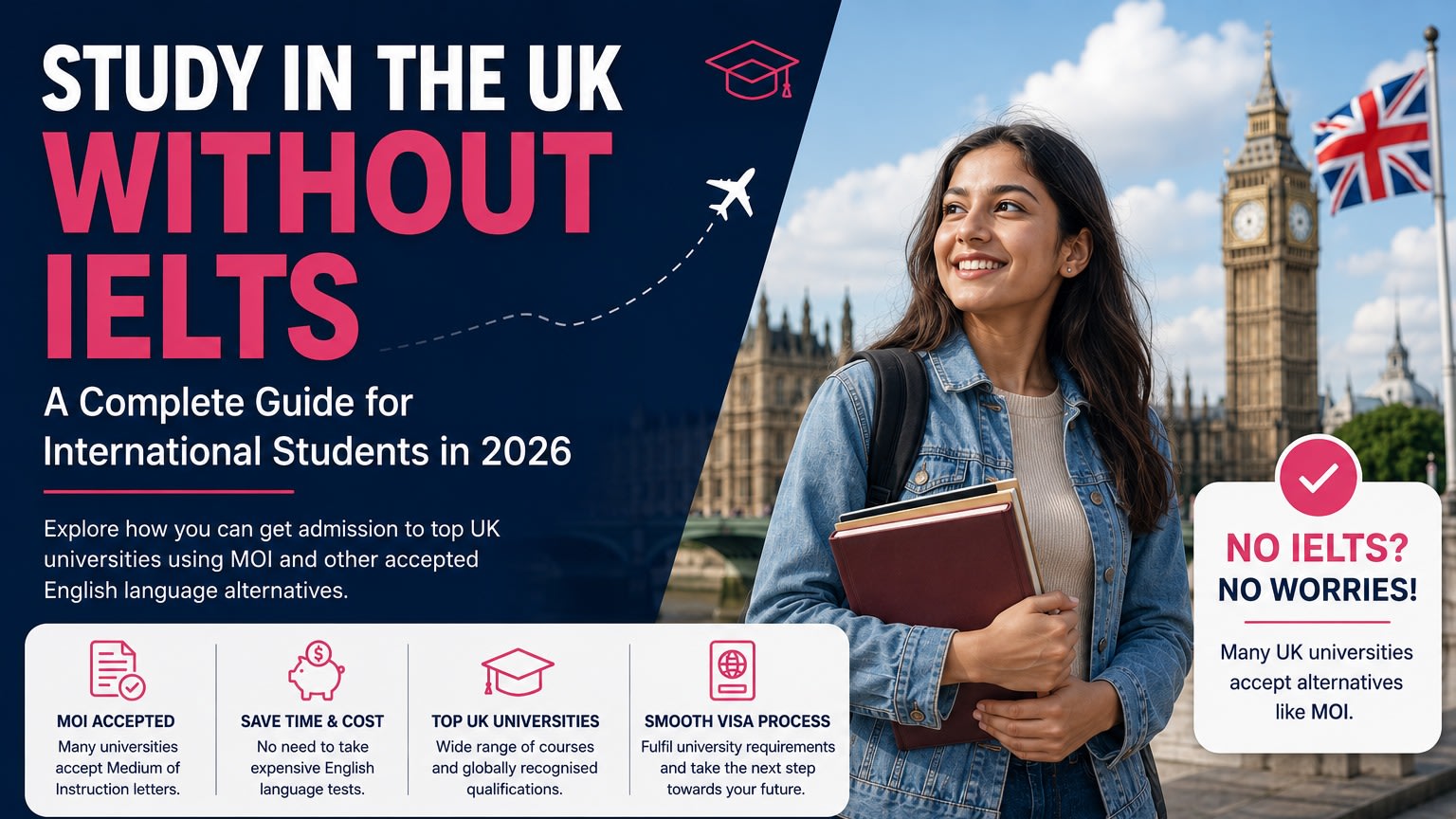
Study in the UK Without IELTS: A Complete Guide for International Students in 2026
For many students, studying in the United Kingdom is a dream. The UK is home to some of the world's most respected universities, offers globally recognized qualifications, and provides excellent opportunities for academic and professional growth. However, one concern often prevents students from taking the next step in their study abroad journey—the IELTS examination.
Many students believe that IELTS is compulsory for studying in the UK. While IELTS is one of the most widely accepted English language proficiency tests, it is not always the only option available. In fact, many UK universities now consider alternative methods of assessing English language ability for eligible students.
If you have been postponing your plans to study in the UK because you do not have an IELTS score, this guide will help you understand the options available and how you may still be able to pursue your education in the UK.
Is It Possible to Study in the UK Without IELTS?
The simple answer is YES.
Many UK universities understand that students who have completed their previous education in English may already possess the language skills necessary to succeed in higher education. As a result, some institutions may accept alternative evidence of English language proficiency instead of IELTS.
Universities assess applicants individually and may consider factors such as:
Previous academic qualifications
Language of instruction during previous studies
Academic performance
Personal interviews conducted by the university
Alternative English language tests
It is important to remember that admission requirements vary from one university to another, and the acceptance of alternatives to IELTS depends on the specific institution and program.
What Is a Medium of Instruction (MOI) Letter?
One of the most common alternatives to IELTS is a Medium of Instruction (MOI) letter.
A Medium of Instruction letter is an official document issued by a school, college, or university confirming that the student's education was delivered in English.
Many UK universities may consider an MOI letter for eligible applicants who have completed their previous studies in English.
Typically, an MOI letter includes:
Student's full name
Name of the program completed
Duration of study
Confirmation that English was the language of instruction
Official stamp and signature of the institution
For many international students, especially those from countries where English-medium education is common, an MOI letter can simplify the application process.
Who May Be Eligible to Apply Without IELTS?
While requirements differ among universities, many institutions may consider students who:
Have completed their bachelor's degree or equivalent qualification in English.
Have recently completed their studies, often within the last few years.
Meet the university's academic entry requirements.
Successfully complete any required interviews or additional assessments.
Universities evaluate each application individually, so eligibility is always subject to university approval.
Why Are More Students Choosing to Apply Without IELTS?
Reduced Costs
Taking an English language test can add to the overall cost of studying abroad. By using accepted alternatives, students may be able to reduce some of these expenses.
Faster Application Process
Students who already possess the necessary academic qualifications can often begin their application process immediately without waiting for test dates and results.
Less Stress and Pressure
Many students are confident in their English-speaking abilities but feel anxious about formal examinations. Alternative pathways can reduce this pressure.
More Accessible Opportunities
Students living in areas with limited access to test centers may find alternative options more convenient and practical.
Popular Alternatives to IELTS Accepted by UK Universities
While policies vary by institution, many universities may accept one or more of the following alternatives:
Medium of Instruction (MOI)
An official letter confirming that previous education was taught in English.
PTE Academic
The Pearson Test of English Academic is widely accepted by many UK universities and is often considered a popular alternative to IELTS.
TOEFL iBT
The Test of English as a Foreign Language remains a globally recognized English language qualification accepted by numerous institutions.
Duolingo English Test
Some universities accept the Duolingo English Test as evidence of English proficiency, although acceptance varies by institution and program.
LanguageCert
LanguageCert qualifications are increasingly recognized by universities and educational institutions in the UK.
Popular UK Universities That May Consider MOI or Alternative English Language Evidence
Many UK universities may consider alternatives to IELTS for eligible applicants. Examples include:
Birmingham City University
Coventry University
University of Hertfordshire
University of East London
University of West London
De Montfort University
University of Greenwich
Northumbria University
University of Portsmouth
The University of Law
University of Sunderland
Leeds Beckett University
University of Chester
Bangor University
Admission requirements change regularly, and acceptance of MOI or alternative qualifications is always subject to the university's latest policies.
Does Studying Without IELTS Affect Your UK Student Visa?
This is one of the most frequently asked questions among students.
The answer is generally NO.
If a university accepts your English language qualifications and issues the necessary documentation for your course and visa application, your student visa application is assessed according to the same immigration rules as other applicants.
The important factor is that the university has evaluated and accepted your English language ability according to its admission requirements.
Students should always ensure they meet all visa requirements and provide accurate documentation during the application process.
Common Myths About Studying in the UK Without IELTS
Myth 1: Every Student Must Take IELTS
Not necessarily.
Many universities accept alternative English language qualifications or MOI letters for eligible students.
Myth 2: Universities Accepting MOI Are Less Reputable
This is completely false.
Several well-respected and recognized UK universities consider alternative evidence of English language proficiency.
Myth 3: Visa Approval Is More Difficult Without IELTS
If your university has accepted your English language qualifications and all visa requirements are met, your application is assessed under the same immigration framework.
Myth 4: Employers Care Whether You Took IELTS
Employers are generally more interested in your degree, skills, work experience, and communication abilities rather than the specific English language test used during admission.
Things Students Should Keep in Mind
Although studying in the UK without IELTS is possible, students should remember several important points.
First, university requirements vary significantly. What is accepted by one institution may not be accepted by another.
Second, some professional programs may still require specific English language qualifications due to accreditation or licensing requirements.
Third, universities may conduct interviews to assess communication skills before making admission decisions.
Finally, admission policies can change from year to year, so students should always verify the latest requirements before applying.
Why the UK Continues to Attract International Students
Even beyond flexible English language requirements, the UK remains one of the most popular study destinations in the world.
Students continue to choose the UK because of:
Globally recognized qualifications
High-quality education
Strong industry connections
Diverse international student communities
Excellent research opportunities
Shorter course durations compared to many countries
Opportunities to gain international exposure
Access to post-study work opportunities
These advantages continue to make the UK an attractive destination for students seeking world-class education and global career opportunities.
How Professional Guidance Can Help
Navigating university requirements, English language criteria, visa procedures, and application deadlines can be overwhelming.
Working with experienced study abroad counsellors can help students:
Identify suitable universities
Understand admission requirements
Explore IELTS alternatives
Prepare application documents
Complete university applications
Receive visa guidance
Make informed decisions about their future
Professional guidance can simplify the process and help students avoid common mistakes.
Final Thoughts
If you have been delaying your dream of studying in the UK because you do not have an IELTS score, it may be time to explore your options.
Many UK universities now consider alternatives such as Medium of Instruction (MOI) letters
While requirements vary between universities and programs, thousands of international students successfully gain admission every year without taking IELTS.
The key is understanding the latest admission criteria, preparing the right documents, and choosing the university that best matches your academic profile and career goals.
With proper planning and expert guidance, your UK study dream may be closer than you think.
Ready to Study in the UK?
At Storm Overseas, we help students identify universities that match their academic profile, career aspirations, and English language qualifications.
Whether you are exploring MOI-based admissions, alternative English language pathways, scholarships, or visa guidance, our experienced counsellors are here to support you throughout your study abroad journey.
Contact Storm Overseas today and take the first step towards your UK education dream.
Bottom of Form