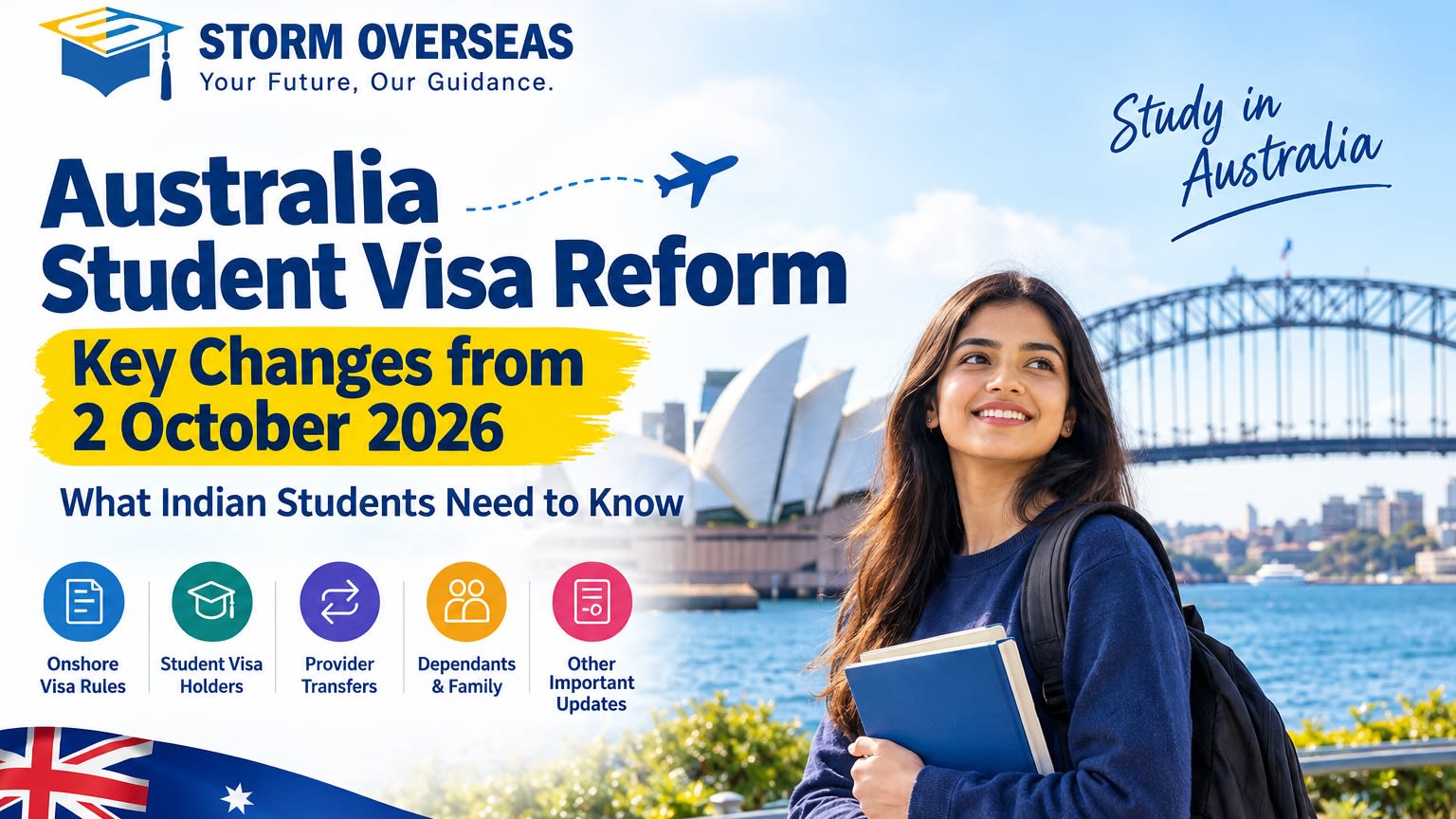
Australia Student Visa Reform 2026: Key Changes from 2 October 2026
Australia has introduced major changes to its Student Visa program from 2 October 2026. The new reforms are aimed at strengthening the integrity of the student visa system, reducing visa hopping and ensuring that international students come to Australia primarily for genuine study purposes.
For Indian students planning to study in Australia, these changes are particularly important. They affect onshore Student Visa applications, transfers between education providers, family members, and the circumstances under which certain visa holders can apply for a Student Visa.
The Australian Government has confirmed that genuine international students can continue to apply for Student Visas, but students now need to plan their studies and visa pathway more carefully.
Let’s understand the major changes and what they mean for students.
What Has Changed from 2 October 2026?
The reforms introduce several important measures:
Stricter rules for applying for a Student Visa while already in Australia
New restrictions for current Student Visa holders applying for another Student Visa
Tighter rules for including partners and children
A temporary increase in the provider-transfer restriction from 6 to 12 months
New rules to prevent students from moving from higher education to VET onshore
A new Student Visa transfer stream planned for 2027
The overall objective is to prevent misuse of the Student Visa system while maintaining Australia as a destination for genuine international students.
1. Stricter Rules for Onshore Student Visa Applications
One of the biggest changes is that most Student Visa applications will now need to be lodged from outside Australia.
Previously, some students already in Australia could apply for another Student Visa onshore depending on their circumstances. Under the new rules, most applicants will need to be outside Australia when applying unless they fall within an eligible exemption category.
This is especially important for students who are already in Australia on another temporary visa and are considering switching to a Student Visa.
The Department of Home Affairs advises applicants to check whether they are permitted to apply onshore before making travel, financial or enrolment decisions. If an applicant is required to apply offshore but submits the application in Australia, the application may be considered invalid.
What does this mean for students?
If you are already in Australia and are considering starting a new course, do not assume that you can simply apply for a Student Visa from within Australia.
Your current visa, your circumstances and any applicable exemption will need to be considered before lodging an application.
2. Current Student Visa Holders Face New Restrictions
The reforms also affect students who already hold a Subclass 500 Student Visa and want to apply for another Student Visa.
A current Student Visa holder who wants to apply for another Student Visa as a primary applicant will generally need to apply from outside Australia, unless an exemption applies.
Limited exemptions exist for certain categories, including some school students, PhD students and specified circumstances such as students affected by provider default or course-related issues.
This means students need to think carefully about their long-term study progression before arriving in Australia.
For example, changing courses or extending your stay should not be treated as something that can automatically be managed through another onshore Student Visa application.
Why is this important?
The Australian Government has described the reforms as part of its effort to reduce “visa hopping”—where temporary visa pathways are repeatedly used to extend a person's stay in Australia rather than following a genuine study pathway.
For students, this makes it more important to select the right course and education provider from the beginning.
3. Provider Transfer Restriction Increases from 6 to 12 Months
Another major change relates to students who want to change their education provider after arriving in Australia.
From 2 October 2026, the transfer restriction period for non-school international students has temporarily increased from six months to 12 months.
This means that, as a general rule, non-school students cannot transfer to another registered provider during the first 12 months of their principal course unless an applicable exception or approved circumstance applies.
This temporary arrangement will remain in place until 30 June 2027. From 1 July 2027, the transfer restriction period is scheduled to return to six months, alongside the introduction of the new Student Visa transfer stream.
Are there exceptions?
Yes.
Transfers may still be possible in certain exceptional circumstances, including situations involving provider or course closure or other circumstances covered by the applicable rules.
School students remain subject to a six-month restriction for their first registered school course.
What should students do?
Students should research their university or college carefully before travelling to Australia.
Look at:
Course structure
University reputation
Location
Tuition fees
Career outcomes
Accommodation
Internship or industry opportunities
Course progression
Future study plans
Choosing a course simply because it appears cheaper or easier to enter may create complications later.
4. New Student Visa Transfer Stream from 2027
The changes do not stop at the temporary 12-month transfer restriction.
From 1 July 2027, Australia plans to introduce a new Student Visa transfer stream for international students who want to change education providers after arriving in Australia.
Under the planned system, students will need to obtain the new Student Visa before commencing study with the new provider.
There will also be restrictions on the direction of transfers.
The reforms are designed to allow transfers at the same Australian Qualifications Framework (AQF) level or to a higher level. Students will not be able to use the pathway to move down to a lower AQF level.
Importantly, students will also no longer be able to come to Australia for higher education and then transfer onshore into VET as part of this pathway.
This is a significant change for students who previously considered using Australia as a pathway to change their course level after arrival.
5. Tighter Rules for Partners and Children
The new reforms also introduce important changes for students planning to bring their partner or dependent children to Australia.
From 2 October 2026, most Student Visa applicants can no longer automatically include family members in their application.
There are limited exemptions, including certain PhD students, nationals of Pacific and ASEAN countries, and students sponsored by Australian or foreign governments.
Another important change is that subsequent entrants are no longer available for Student Visa family members.
In circumstances where family members are permitted to accompany the student, they generally need to be included at the time the primary student applies.
However, the Government has stated that eligible families who are already together in Australia will not be separated simply because of these changes.
What does this mean for Indian students?
Students from India who are planning to study in Australia with their spouse or children should assess their family situation before submitting the visa application.
Do not assume that your partner or children can simply join you later under the previous process.
6. Certain Temporary Visa Holders May Need to Apply Offshore
The reforms also restrict Student Visa applications from Australia for certain temporary visa holders.
The Australian Government has specifically highlighted that many temporary visa holders—including people holding certain work-related or other temporary visas—will no longer be able to simply switch to a Student Visa while remaining in Australia.
The exact rules depend on the visa held and the circumstances of the applicant. Therefore, students already in Australia should check their eligibility before making a course or visa decision.
This makes professional assessment particularly important for anyone planning a transition from another Australian visa to a Student Visa.
7. What About Applications Lodged Before 2 October 2026?
There is an important transitional point for students.
Student Visa applications lodged before 2 October 2026 continue to be assessed under the rules that applied when the application was lodged, including applications that included family members.
Therefore, the date of lodgment matters.
Students should keep copies of their application, supporting documents and acknowledgement of lodgment for their records.
Why Has Australia Introduced These Reforms?
According to the Australian Government, the reforms are intended to strengthen the integrity of the Student Visa program and ensure that the visa is primarily used for its intended purpose—temporary stay in Australia for study.
The Government has particularly focused on reducing visa hopping, unnecessary provider transfers and pathways that may allow students to move into lower-level courses or use education as a means of extending their stay.
The reforms are therefore not a ban on international students.
Australia continues to welcome genuine international students who meet the relevant visa and study requirements.
What Should Indian Students Do Now?
With these changes in effect, careful planning has become more important than ever.
1. Choose your course carefully
Before accepting an offer, understand exactly what you will study, how long the course will take and what your progression options are.
2. Research your provider
Check the institution, course structure, location, fees and student support services before making a commitment.
3. Avoid planning your study pathway around visa switching
Students should focus on building a genuine and logical academic pathway rather than assuming they can change their course or visa after reaching Australia.
4. Understand your visa position
If you are already in Australia, check whether you are eligible to apply for a Student Visa onshore or whether you need to apply from outside Australia.
5. Plan your family arrangements early
If you want to take your spouse or children to Australia, understand the new family-member rules before lodging your application.
6. Take provider transfers seriously
The temporary 12-month transfer restriction means that changing institutions soon after arrival may not be as straightforward as it was previously.
7. Get updated advice before lodging
Australian immigration rules can change, and individual circumstances can produce different outcomes. Always check the latest information from the Department of Home Affairs before making financial, travel or visa decisions.
Final Takeaway
Australia's Student Visa reforms from 2 October 2026 represent a significant shift towards a more tightly controlled and integrity-focused international education system.
For students, the key message is simple: choose your course carefully, select your provider wisely and plan your visa pathway before you travel.
The new rules make it more difficult to rely on onshore visa switching or quick provider transfers after arriving in Australia. At the same time, genuine students who meet the requirements can continue to pursue their education in Australia.
For Indian students planning an Australian education in 2026 or 2027, getting the right guidance at the beginning can help avoid costly mistakes later.
Planning to study in Australia?
At Storm Overseas, we help students understand their course options, admission process and visa pathway so they can make informed decisions about their international education journey.
Your Future, Our Guidance.
Disclaimer: This article is for general informational purposes only and should not be treated as legal or migration advice. Australian visa rules can change, and eligibility depends on individual circumstances. Students should check the latest information from the Australian Department of Home Affairs or seek advice from an appropriately qualified professional before making visa or travel decisions.